The Perfect Escape to Shetland
On my most recent trip to Shetland, I left the city on a wee tartan plane, and landed next to a beautiful beach at Sumburgh. My first time off the mainland since lockdown, I was in search of adventure and escapism, in this new world of social distancing and adapted measures. Here’s how I got on.
This post is part of a paid campaign with Promote Shetland and Loganair to give an honest review of the experience travelling to Shetland and at the destination.
Let’s take a virtual journey to Shetland. From the device you’re using, go to Google Maps and travel from your current location to the Shetland Islands. You’ll find this remote archipelago way above the Scottish mainland, past Orkney, on the route to Norway.
Shetland has deeply rooted connections to Scandinavia. The islands were ruled by the Norse until 1469, when the Kingdom of Denmark pawned Shetland and Orkney to Scotland, after failing to cover the dowry for the marriage of Princess Margaret to King James III of Scotland. Even when the funds were raised some years later, the islands were not returned, and have remained part of Scotland ever since.
Shetland sits at the furthest north you can call Scotland, and the isolated location is what makes these islands so special. The distance from the mainland keeps the crowds at bay, and you can easily alternate between having friendly encounters with the locals to seeing virtually no one at all.
When you travel to Shetland, you are embarking on a great adventure. Shetland’s wild character and wide open spaces will pull you in, and send you home in a different state of well-being. There’s “getting away from it all”, and there’s taking a trip to Shetland.
Here are my top suggestions for embracing Shetland in all its fascinating, untamed glory.
The current situation in Shetland
At my time of travel, Shetland had recently re-opened for tourism and local businesses had implemented a number of measures in-line with the new regulations. Like many remote and rural communities, there are some divided views amongst locals about people arriving from the mainland or overseas.
I had a really positive experience, and while some of the locals I encountered said that they were (understandably) concerned about visitors arriving on the islands, I was made to feel very welcome. In fact, many of the locals seemed delighted to have some new people to converse with again.
There are businesses in Shetland who benefit greatly from tourism, and therefore really appreciate the support during these difficult times. If you are considering a post-lockdown adventure to Shetland, I would absolutely recommend it, and would just urge you to ensure that you travel safely and responsibly, with consideration for the local communities.

What to expect + tips for responsible travel
- You can support Shetland businesses by shopping locally, eating out, travelling with a local guide, booking an activity and staying in a locally-run accommodation.
- Advanced booking for hotels, restaurants and activities is essential so that businesses can manage capacity.
- Wash your hands regularly and carry your own hand sanitiser when you’re out for the day. Hand sanitiser is provided in some public places and by local businesses, and should be used accordingly.
- Maintain social distancing at all times, and be sensitive towards locals who might be nervous about being exposed to the virus.
- Masks must be worn in shops and supermarkets – unless you have an official exception.
- If you are wild camping or travelling in a motorhome/campervan, shop locally instead of bringing everything with you, and ensure that you leave no trace: don’t disturb the natural environment and take your rubbish with you.
- Be aware that many of the museums and heritage sites will remain closed for 2020: they are often staffed by locals and volunteers who are high-risk. Check online before you visit or phone ahead to avoid disappointment.

The travel experience
My flight from Edinburgh to Shetland was the first time I had been on a plane in 2020. I was quite apprehensive ahead of the journey, but it was far more relaxing and enjoyable than I had expected. Things are clearly very different to what they were before, but not to the detriment of the experience.
Edinburgh Airport is very well set up for safe travel and social distancing. When I stepped off the airport bus, I quickly spotted the coloured floor graphics which direct you into the terminal, and through the building, as part of the new one-way system.
There were hand sanitising stations before you enter the building, before and after security, and in the Departure Lounge. You do have to wear a mask at all times, and nearly all the other passengers I observed were wearing one. Not all of the retail/catering outlets were open, but I was still able to get a coffee and toastie for breakfast, and shop for some toiletries.

The airport was noticeably quiet, with no queues at check-in or security. I’m a big fan of the buzz and holiday atmosphere in my local airport, and though this can’t really be felt at the moment, this does allow for a more peaceful and stress-free journey.
The flight with Loganair was equally pleasant. During boarding we were issued with an NHS leaflet on COVID-19 and safe travel to Shetland, which was an effective reminder of our responsibility as visitors. On-board the aircraft, the middle seats are not allocated to allow for social distancing: the extra space was a wee bonus.
Masks are required for the duration of the flight, but this doesn’t apply to small children, infants and those who are unable to, due to personal/medical reasons. Given the short flight time, I didn’t become too uncomfortable and the views of the Moray Firth, north coast and Orkney Islands kept me well distracted.

The much-loved, complimentary tea and Tunnocks Caramel Wafer are not provided at the moment, but you can ask the Flight Attendant for some water. I definitely made up for this with treats when I was in Shetland!
I understand why people are worried about flying at the moment, but I can honestly say that I never felt like I was at risk or putting anyone else at risk throughout the journey. Social distancing is more of an issue in the street or supermarket in Edinburgh than it was at the airport or on the flight.
I love flying to the islands on Loganair’s wee planes and this time was no different.
- From more information on how to Fly Safe, visit the Edinburgh Airport and Loganair websites.

10 things to do in Shetland
1) Explore Eshaness
This rugged peninsula on the north-west of Shetland showcases the remnants of an ancient volcano (as in 350 – 400 million years old ‘ancient’) which ended up in this part of the world as the continents drifted and shifted. Dore Holm now sits as an uninhabited wee islet, and a distinctive feature on the area’s seascape.
The Drongs are a series of epic sea stacks, which can be seen from Braewick Café – which is a lovely spot for lunch or tea and a scone. They looked spectacularly atmospheric under a shroud of mist on my visit.

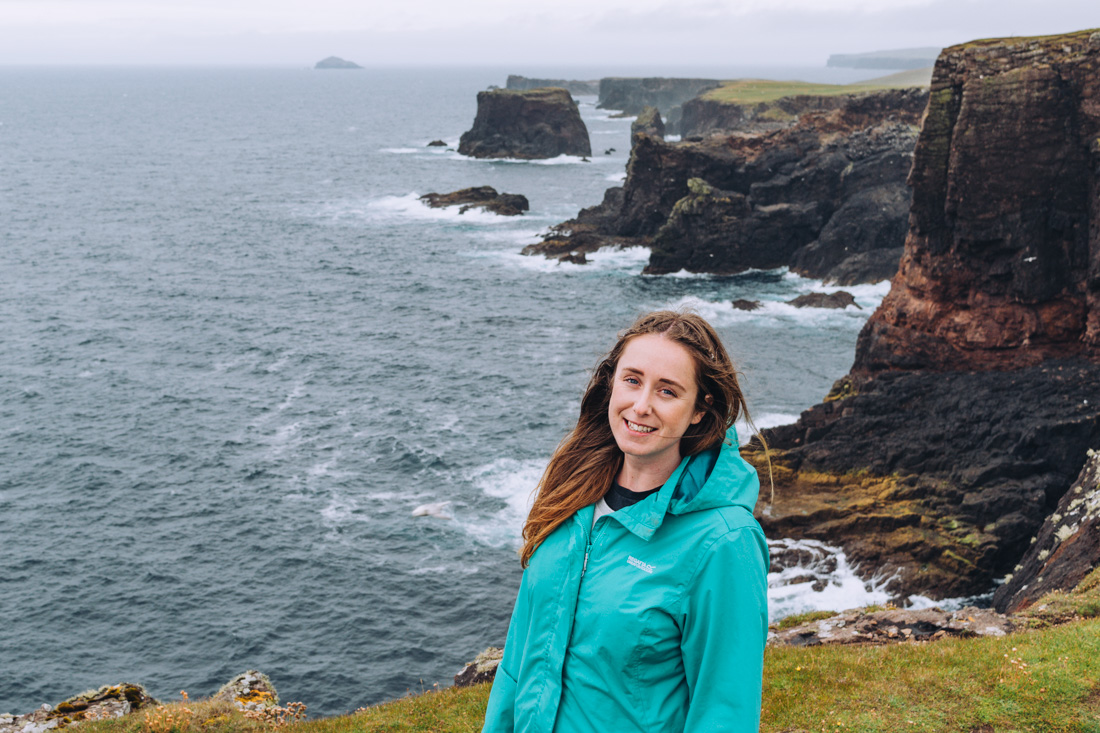
The cliffs at Eshaness are the real highlight, and are best viewed from the area next to Eshaness Lighthouse: dating back to 1929, this was the last of the manned Stevenson Lighthouses to be built. Witnessing the power of the unruly sea as it pounds against the seemingly endless cliffs is a sight to behold: it’s like being at the edge of the Earth.
Fans of BBC’s ‘Shetland’ may recognise the dramatic, narrow inlet Calders Geo from Season 3, in the scene where Perez is chasing Maguire towards the cliffs. Please don’t be tempted to take photos too close to the edge – I felt uneasy even at a distance.
- I explored Eshaness on a private tour with a lovely local called Drew Ratter. You can book a tour with Drew here

2) Go for a paddle with Sea Kayak Shetland
The sea plays a lead role in the story of Shetland, and very much shapes the identity of these unique islands; from the arrival of the Vikings in the 9th century to the development of the fishing and oil & gas industries. You’re never far from the sea in Shetland, and you can get even closer to the water on a trip with Sea Kayak Shetland.
I joined a guided kayaking trip down Ronas Voe, a stunning fjord with vibrant red granite on either side, and the clearest of water beneath which sparkled in the sun. We left from the pink-coloured beach, known as The Blade, and paddled along the coast, through sea stacks and arches, and into caves.

Wildlife encounters are probable on this route. We were followed by a pair of curious seals, who came surprisingly close to the group, and we later drifted towards a gathering of puffins on the surface of the water. Exploring Shetland’s coastal gems by kayak is an experience you’ll never forget.
- For more information, visit Sea Kayak Shetland

3) Experience island hospitality in a local hotel
The Shetland locals are a welcoming bunch and I could listen to their lovely, lilting accents all day. Choosing to stay in a hotel rather than self-catering accommodation gives you the opportunity to get to know the local owners, who without doubt will provide the best stories, recommendations and hospitality. I love quirky accommodation and historic buildings, and there are two Shetland hotels which fit the bill perfectly.

Busta House Hotel
The oldest part of Busta House Hotel dates back to 1588, and it’s not surprising to hear that a building this age has an interesting, yet sad, tale to tell – and a resident ghost! The hotel is owned by local friends Joel and Grant, who both worked at the hotel for years before being given the opportunity to buy it.

I loved the old-fashioned interior and the rooms which are each named after one of Shetland’s many islands. I recommend ordering the seafood options when dining at the hotel: the mackerel pâté and Shetland salmon in parsley and garlic butter were both delicious. The team of young, local staff were excellent, and I’m glad I took Grant’s advice and went for a walk to Mavis Grind and the Islesburgh chambered cairn.
- For more information or to book visit Busta House Hotel

Mavis Grind: a narrow strip of land in the north of Shetland which separates the Atlantic and the North Sea.
St Magnus Bay Hotel
The family-run St Magnus Bay Hotel was built in 1900 for travellers who arrived on paddle steamers in the bay just outside. Back then, there were 30 small rooms on each floor with just one shared toilet. The wooden-clad interior and exterior is as quirky as they come, and while the owners are constantly reinvesting in the development of the hotel, great care has been taken to retain the original feel and history of the place.


Andrea and Paul are the perfect hosts and are so genuinely passionate about looking after their guests. I was welcomed to my huge, sea view room with a tray of tea and homemade cakes, and that was just the start of the feeding frenzy. Andrea loves to serve giant portions of quality food, from hot croissants and scrambled eggs with Shetland smoked salmon for breakfast, to the colossal Shetland surf and turf for dinner.
I loved returning to the hotel after a day of island exploration, for a chat with Paul and Andrea, a hearty meal, or a soak in my jacuzzi bath.
- For more information, visit St Magnus Bay Hotel

4) Walk to Fethaland
You know you’re in for a special treat when you’re off to visit a hidden gem in an already remote location like Shetland. The Fethaland peninsula is at the very top of Mainland Shetland, and was once a bustling haaf (deep sea) fishing station with up to 800 male workers during the summer season.
The picturesque remains of the workers’ lodges can still be seen around the shoreline: these buildings could probably be classed as modern when compared to the prehistoric ruins which sit alongside them.
A strip of land separates two attractive bays: one sandy and one rocky. I listened to the subtle sound of the calm sea while watching a seal swim contently around the sandy side: occasionally bobbing its head out of the water for a look around.
Fethaland certainly isn’t on the tourist trail, and you’re unlikely to come across many other people at this somewhat secret spot. It is one of the most beautiful places I’ve even seen.
- You can walk to Fethaland from Isbister following this route on Walk Highlands.

5) Go puffin spotting at Sumburgh Head
At the very opposite tip of Mainland Shetland is Sumburgh Head, this striking most southerly point is where you’ll find Sumburgh Head Lighthouse perched on a stage of steep cliffs. During the summer months, the cliffs are alive with birds, including the cutest wee colourful characters, and my favourite birds, the puffins!
The area is an RSBP Nature Reserve and there are often staff around to answer any questions. Watching puffins as they come in to land is a clumsy and comical spectacle. They are truly mesmerising. Sumburgh Head is also an excellent location for spotting marine life, so keep an eye on the water too.
- For more information about Sumburgh Head, visit the Sumburgh Head website and RSPB Sumburgh Head

6) Discover the Lodberries in Lerwick
Lerwick is Shetland’s port and main town, but there’s still calm to be found in even the most populated area. A wander along the waterfront will bring you to a stretch of stone houses known as the Lodberries. The first Lodberry was built in 1730, and their position in the sea makes for the prettiest of pictures.
One Lodberry in particular has become quite the seaside celebrity, since it is now the fictional home of DI Perez in BBC’s ‘Shetland’. Despite being popularly photographed, you won’t have to fight through any crowds to take one of your own. I love to stand in this peaceful wee pocket of Lerwick and watch the sea as it laps against the wee ramps, steps and beaches.

6) Eat fish & chips by the sea
There’s nothing quite like tucking into freshly prepared fish and chips with a view of the sea. Frankie’s Fish & Chips sits overlooking the bay in the village of Brae, and this local favourite has won multiple awards – including the best independent takeaway fish and chip shop in the UK in 2015 – for their (not so) little fishy in a dishy with chips.
You’ll also find mussels, scallops and langoustine tails on the menu at Frankie’s, and the seafood is all sourced from local markets which are supplied from sustainable fisheries around Shetland’s coast. Fish and chips always tastes better outside, and if you do decide to eat alfresco, all of the takeaway packaging is biodegradable with not a bit of plastic in sight.
- For more information and to view the menu visit Frankie’s website here

8) Hop on the ferry to Bressay
Lerwick is sheltered by the neighbouring Isle of Bressay, which sits just across the water and can be reached in just 7 minutes by ferry. The island is perfect for day-trippers, but can easily warrant a longer stay for those who want extra time to relax and explore.
There is a hotel with a bar and restaurant at the ferry port and a lighthouse which you can stay in. You can also visit Bressay Heritage Centre and have lunch in Speldiburn Café, which was once the primary school on the island.
No visit to Bressay would be complete without a tour of Garths Croft. The idyllic wee croft is the dream-child of Chris Dyer and his Orcadian wife, who bought it 5 years ago. Chris is an Archaeologist from down south (near Luton, so really ‘down south’), who moved to Shetland 15 years ago to work in heritage tourism.

Chris has now taken on the crofting way of life, raising native and heritage breeds, amongst many other pursuits: growing fruit and veg, joinery, building drystone dykes, and volunteering in the fire service.
Meet the sheep, pigs, and playful sheep dog, while learning about traditional crofting and the island way of life. Chris can also combine a visit to the croft with a tour of the island. If you’re interested in crofting, textiles, sustainable living, heritage, or anything to do with island life, you’ll love it here.
- For more information, you can contact Chris through the Garths Croft Instagram page

9) Step back in time at Jarlshof
Shetland’s Norse heritage is widely known and well celebrated at the annual Up Helly Aa festivals. There are many other layers to Shetland’s history however, and you can see them literally side-by-side and on top of one another at the amazing Jarlshof. This remarkably well-preserved site holds over 4,000 years of human history in one place.
The location has been a desirable place to settle through the millennia, and the site remained hidden and protected by the earth until it was unveiled by a storm in 1890. Now you can witness what’s been left there from the Bronze Age, Iron Age, Norse era, medieval times, and the 16th century. Explore the homes of humans from many lifetimes ago, and browse the range of artefacts in the visitor centre.
- For more information and to check when Jarlshof is reopening, visit Historic Scotland

10) Find your perfect beach
If you think stunning beaches with turquoise sea can only be found on the Western Isles, think again! Just like the clean air, Shetland’s waters are beautifully unpolluted, making them crystal clear and very inviting – despite the chilly temperature. The most famous of Shetland’s beaches is the tombolo between Mainland and St Ninian’s Isle. This incredible sandy walkway can be accessed at low tide, and you can check the best times here.
Meal Beach on Burra is another wee slice of paradise, which still looked like it belonged in the tropics when I visited back in January 2017. On my most recent trip, I discovered the blissful bay at Hillswick on a morning walk from my hotel. A section of large, smooth pebbles gives way to soft sand, and then to the Atlantic. I went for a swim on a hot summer’s eve and it was wonderful!
- For more Shetland beach inspiration click here

Getting around in Shetland
On my trips to Shetland, I have used a mixture of local buses, taxis, lifts from my hosts, and even an eBike – which will be available to hire from Hillswick Shop in future. If you are planning to drive, you can hire a car when you arrive on the island. Here are some useful links:
- ZetTrans – information, fares and timetables for Shetland’s public transport network. There is also an app. which you can download to help plan your journeys.
- Bolt’s Car Hire – a family-run business based in Lerwick
- Allied Taxis – a Lerwick-based service which operates 24 hours a day
